
Review of a Single Exchange in the Trump-Harris Debate
Public discourse as hand-waving woo-woo

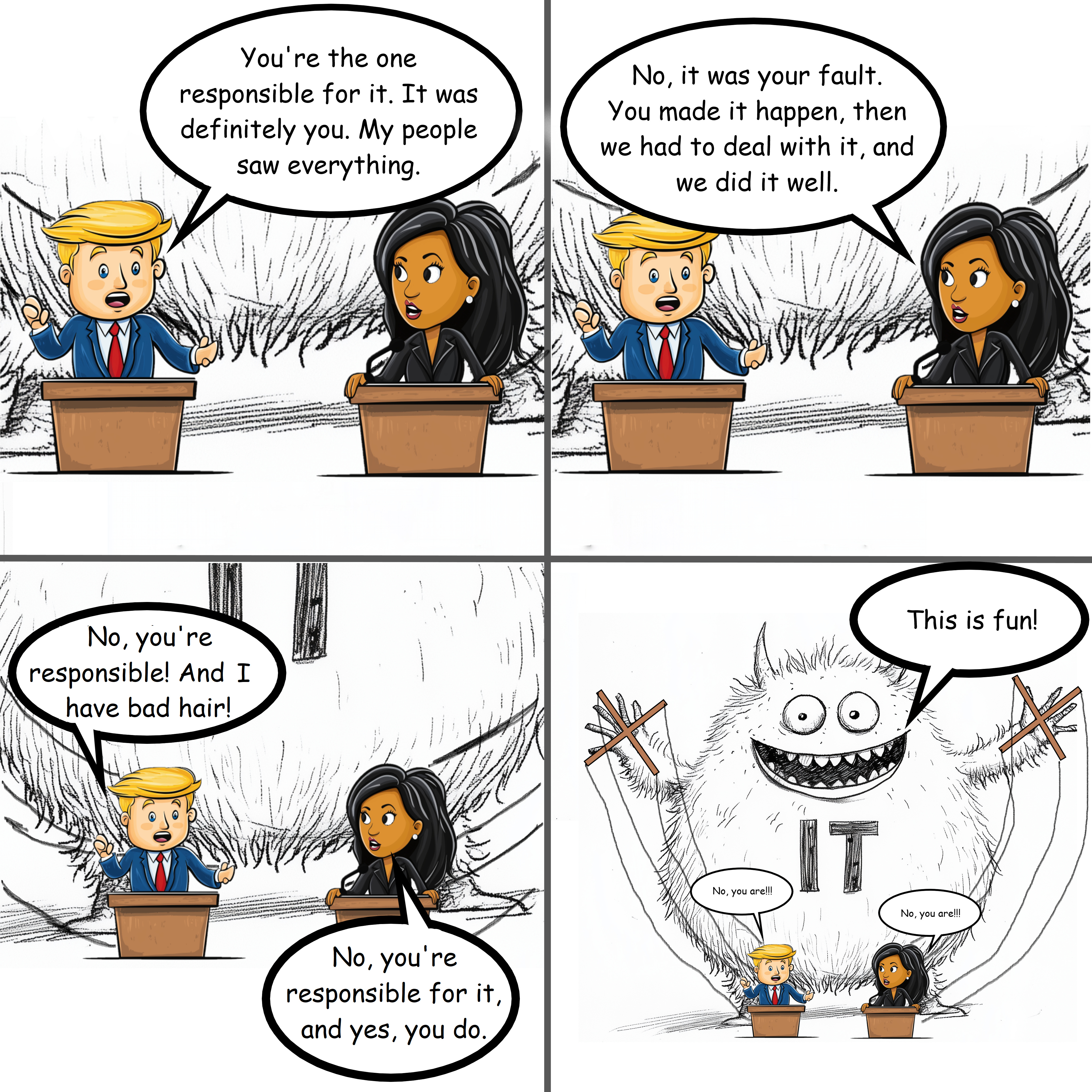
This Week’s Song — If You Say So
TLDR
As with all political theater, the Trump/Harris debate is a thin veil of performance that obscures a whole reality of small, interesting, and vitally important political details. I can’t even begin to cover them all, so I didn’t try. Instead, I looked at the complexities hidden in a single exchange between Trump and Harris—one that didn’t even last for five minutes. I found relevant graphs for several points and unpacked them. The result is this article.
Table of Contents
I. Introduction
II. The state of the economy at the handoff
III. The level of unemployment at the handoff
IV. Biden and Harris’ effect on unemployment
V. Biden and Harris’ effect on inflation
VI. So what happened?
VII. This Week’s Song - If You Say So
VIII. Footnotes
Introduction
The first time I read John Salvatier’s masterful essay, Reality Has a Surprising Amount of Detail, I found my theme—not just for this newsletter, but for life. Life is detail, and details are awesome—whether you are counting autumn leaves or keeping a bulleted list of observations about toddlers babbling, the act of attending carefully to the details of just about anything is a delight.
For most people the question is not if details are interesting—it is which details are interesting. Athletes wrestle for months with small kinesthetic variations to improve their sprint by seconds. Artists geek out about subtle shades of teal that the rest of us would dismiss as murk. If you are dialed in to something, anything, really, you’re invested in its minutiae.
Salvatier’s essay also gave me a language to describe pathology. If details are a byproduct of investment, lack of detail is a sign of ennui. Mental illness severs us from details, replacing it with compulsive patterns that overwrite the chaotic nuances of life. By that token a sure sign of the pathological nature of politics is its lack of detail.
Politics is technical. A savvy national politician has loads of details to talk about, from the particulars of the bill they just signed to the gossip about whatever bullshit the ambassadors to Croatia1 are getting up to. These details are (or at least can be) fascinating; we know that because whenever a politician fucks something up, the media lights up with endless discussions of the details around the fuck-up.
But when everything is going good we rarely get those details, because it’s not in politicians’ interest to share them. A breaking news special is a broken dam, flooding the internet with details politicians prefer to keep in reserve. Instead, what we usually get from politicians is political theater—a pathologically simplified performance meant to rally voters by hitting their emotional buttons.
The Trump-Harris debate is classic political theater; a small raft of drama floating on top of a sea of details. It makes for a great illustration. Here, I want to narrow in on a single exchange between Trump and Harris. You can see it here. I want to take this opportunity to pop the hood of their rhetoric so we can examine the rumbling engine underneath. So here goes.
The state of the economy at the handoff
“We had the greatest economy. We got hit with a pandemic. And the pandemic was, not since 1917 where 100 million people died has there been anything like it? We did a phenomenal job with the pandemic. We handed them over a country where the economy and where the stock market was higher than it was before the pandemic came in.” — Trump
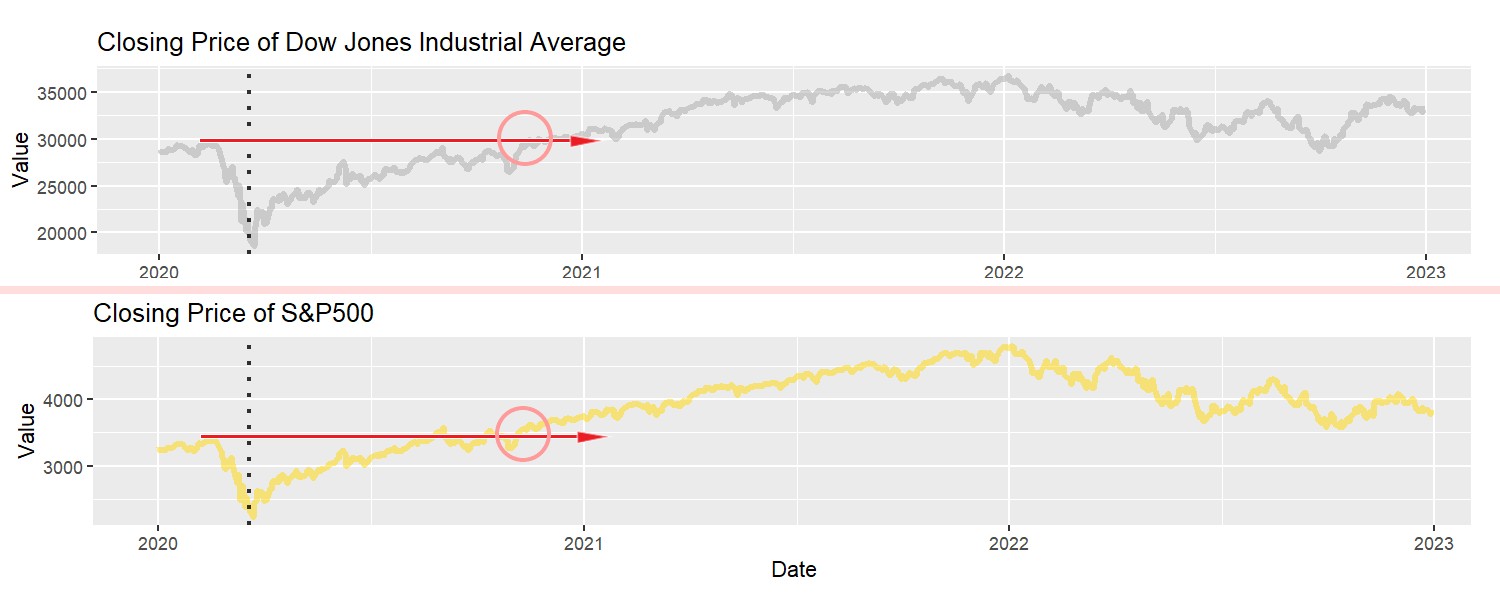
The graph above shows the historic prices of two index funds: the Dow Jones Industrial Average and the S&P 500. The dotted line represents March 19th, 2020, which is when the lockdowns were first implemented in California. The red arrow shows the price of each stock prior to the crash, and the circle shows where the post-Covid price surpassed its pre-Covid high. Note the sharp decline leading up the the lockdowns—that happened when Covid arrived on U.S. soil. The fear and uncertainty spurred caused a stock market crash.
Then it improved, and continued to do so even as hundreds of thousands of Americans were dying. I find this fact so baffling that I wrote a full article about it.
Trump is technically correct: his administration was at the helm as America experienced its massive turnaround. The turnaround coincides roughly with the day that the lockdowns started in California, but the lockdowns were just the visible indicator of a lot of behind-the-scenes work going on in the government. The first stimulus bill, the Families First Coronavirus Response Act, was signed into law by Trump on March 18, 2020, authorizing $192 billion in federal spending. Two additional bills quickly followed, culminating in the $2.2 trillion dollar CARES act signed into law on March 27th.
It is less clear what Trump himself contributed. If you want to get a sense of it, this document offers a pretty compelling timeline of his response to the crisis. Granted, the document focuses primarily on his public comments, but it does not depict a man who had things under control.2
It’s tempting to suggest that the market recovery was due to the massive infusion of cash from those bills, as if it were a simple, mechanical matter of money in/money out. But the economy is notoriously responsive to the psychology of the people—the money was certainly important, but it was disbursed over a long stretch of time. More importantly, it reassured people that things were going to remain stable, financially. That kept them spending and working, helping them negotiate the reality of the lockdowns, keeping the gears of America turning.
Importantly, I am not sure that Trump added to this process. From his perspective it must feel like he did. Picture this: You’re president of the United States. The economy is crashing. You bellow at Congress to do something. You shake some hands and offer a monosyllabic opinion. Congress brings you a piece of paper, which you sign, and shortly afterwards the stock market crash has reversed.
If I was a narcissist who ignored the people under him, that would feel heroic.
Less obvious is what would have happened if anybody else had been in Trump’s place at the time. What is Trump’s VORP (Value Over Replacement President) score? If we had swapped his administration out with any other administration, would the result have been different? What if it was Clinton, instead? Or what if we lived in a strange alternate reality where Congress had to bring every bill in front of a screaming chimpanzee in a suit who would smear it with their own feces before it was considered signed into law? In any of those universes, would we have seen the same economic turnaround, at (about) the same time?
I think we might have.3
Because from here it doesn’t look like Trump did much to help the turnaround. I’m happy to be educated on this if you have a good counter-case, so feel free to comment, but to me it looks like he got in the way, at several points. More importantly, it looks like Congress recognized an overwhelming threat and united to save their country, even if only for a brief moment. I think fear made them get things done, not Trump.
My tentative verdict on this, then, is: Trump is saying things that make sense from his perspective. But his perspective may not represent what he and his administration actually added.
The level of unemployment at the handoff
“Let’s talk about what Donald Trump let us. Donald Trump left us the worst unemployment since the Great Depression. Donald Trump left us the worst public health epidemic in a century. Donald Trump left us the worst attack on our democracy since the Civil War. And what we have done is clean up Donald Trump’s mess.” — Harris
This is a hefty quote. It’s the first major body blow that Harris dealt to Trump in this debate—the rhetorical equivalent of a punch to the liver. I’m going to deal with the bit about unemployment since that’s the one I can produce a graph for.4
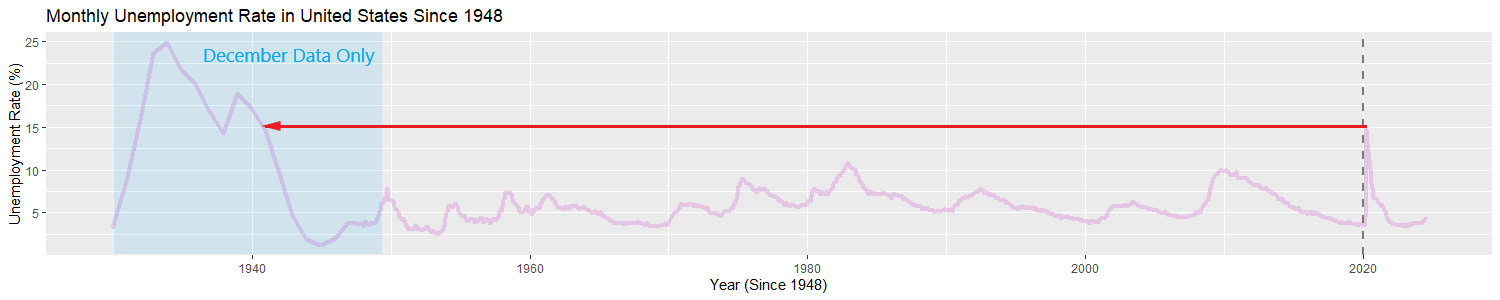
The Bureau of Labor Statistics started collecting employment information regularly in 1948. Unemployment data for the years 1929-1939 was collected retrospectively for December of each year.5 By that measure, the worst level of unemployment we have on record was from the year 1933, at 24.9%.
In 1939 the unemployment rate was 17.2%. In 1940 it was 14.6% and rapidly dropped to a record low of 1.2% in 1944. Monthly records of unemployment started in 1948 and have continued unbroken since then. So we have monthly numbers from 1940 onward, and intermittent numbers from the years prior to that. Those numbers show two things.
Donald Trump was president during the highest and most rapid unemployment spike in American history—April 2020, right after the Covid lockdowns, when unemployment jumped to a high of 14.8%.
That spike is the highest unemployment on written record since December of 1939. For those who noted that the red line in the graph above stops in 1940—the unemployment rate in December of 1940 was 14.6%, which is still lower than the 14.8% high in April 2020.6
Over the next few months that same spike was reversed and plummeted to around 6.4%, which is where it was when Trump passed the reins to Biden.
So how do we read this? It depends on how you interpret Kamala Harris. Her statement could mean two things. It could mean “At the time you handed over power the USA had the highest unemployment rate since the Great Depression,” which sounds devastating but is completely false. The unemployment rate when Trump passed the reins to Biden in January of 2021 was at 6.4%—lower than it was during the first half of the Obama administration.
Alternately, Harris could have meant “You presided over the U.S. during the single worst unemployment crisis in 80 years and the damage wasn’t all fixed when you handed it to us—me and my team had to bring the nation back to healthy.” That version is true; it was Biden and Harris whose tenure saw the unemployment decrease back to pre-pandemic lows.
Harris is a seasoned prosecutor. I don’t think people appreciate just how much high-class lawyers focus on the nuances of their public statements and their manner of presentation. When she makes a vague statement that implies one thing while still leaving herself plausible deniability, she knows she’s doing it.
So, the tentative verdict: Harris was probably being deceptive, forcing Trump to take a hit on his handling of the pandemic by exaggerating how poorly he did while leaving herself enough wiggle room to write it off as hyperbole.
Biden and Harris’ effect on unemployment
“But the only jobs they got were bounce-back jobs. These were jobs, bounce back. And it bounced back and it went to their benefit. But I was the one that created them. They know it and so does everybody else.” — Trump
The first time I heard this I laughed. It seems pretty clear, here, that Trump is trying to pull double-duty with his statement. First he tries to rob Biden and Harris of their accomplishments by claiming that whatever jobs they secured for the American people were due to a simple, reflexive bounce-back from the pandemic. Then he tries to take credit for the bounce-back himself.
I’m not sure he can, though. Let’s take a look at the graph of unemployment again.
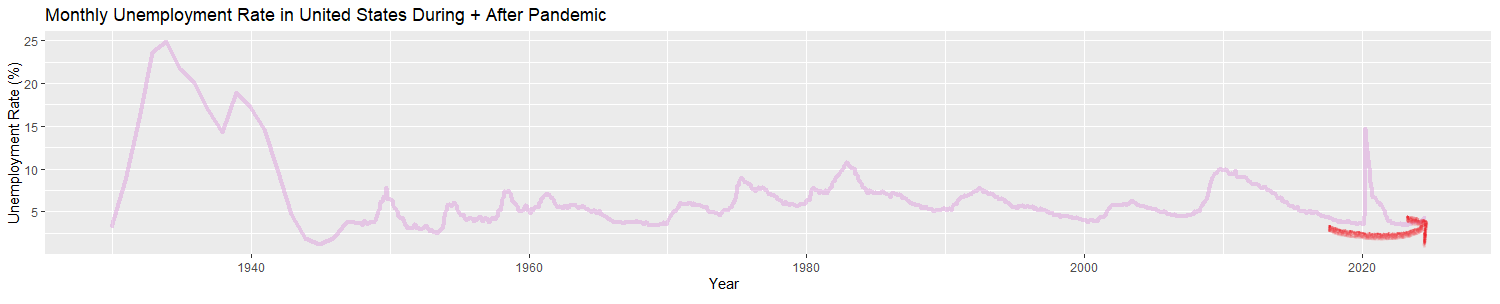
I’d like you to note how incredibly weird the unemployment spike and resolution during COVID was. Most spikes since 1980 hit hard and resolve slow. The pandemic spike is not only the greatest unemployment crisis since the Great Depression—it is also one of the fastest recoveries since the 1960’s. It doesn’t reflect a job market cycle—it reflects an aberration in an otherwise normal cycle. Rather than industry not having jobs for people, the industry had lots of jobs—but people had to quarantine, so those jobs sat there, waiting for people to figure out how to fill them.
Once those jobs could be filled, they were, rapidly. What’s intriguing to me, though, is that the bounce-back clearly stops at some point in late 2020 and is replaced by some other, slower form of recovery, which continued uninterrupted under Trump’s tenure for months before he passed the presidency to Biden. Let me show a zoomed in version of the above graph so that we can see those segments more clearly.
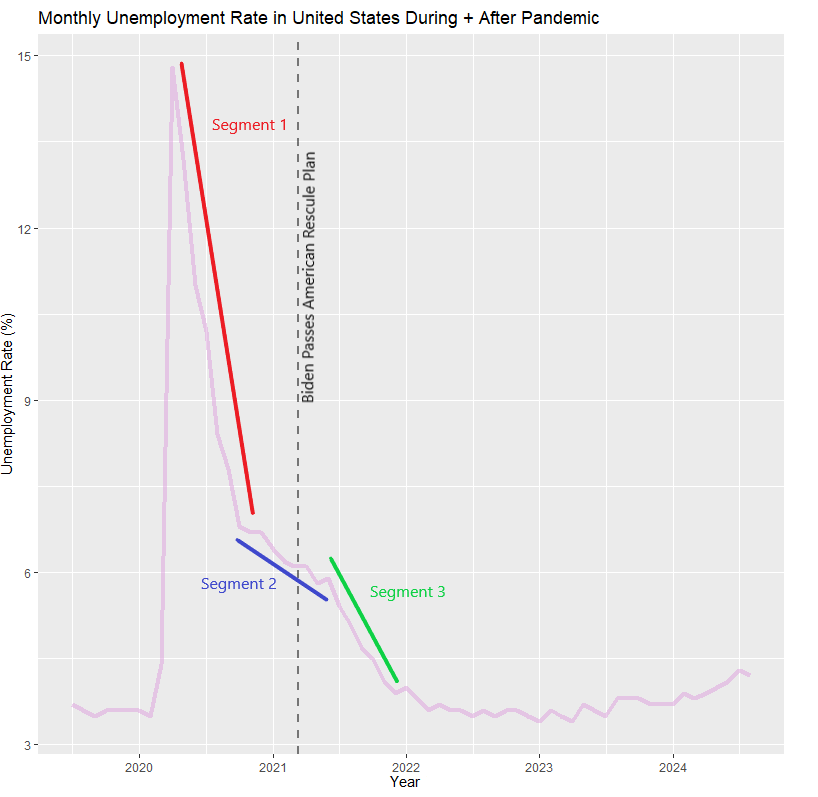
If I had to guess at the explanation for each of these three segments, it would be as follows:
The natural bounce-back from the pandemic, where eager employers meet equally eager employees as they all struggle to change the basic infrastructure of employment so that as many people as possible can return to work. Likely driven by large businesses—the type for whom the pandemic challenge was one of internal reorganization, rather than existential threat.
A slower period of recovery where increasing employment represents jobs being created. Smaller businesses that were severely damaged by the pandemic are limping along towards health as lockdowns end, finding their footing, hiring people as they are able to.
A period of rapidly accelerating recover under Biden’s stimulus plan, down to the previous low rate prior to the pandemic.
The job increase under the Biden-Harris administration likely wasn’t bounce-back. The strongest evidence for this is that the trajectory of unemployment statistics changed shortly after they passed the American Rescue Plan. The easiest way to see their effect is to look at the extrapolated trajectory from the Trump administration vs. the actual trajectory under the Biden administration.

That may not seem like a huge amount—just eyeballing it, it looks like the difference between returning to normalcy in February of 2022 instead of August. But remember that the percentages we are looking at here represent people, not mere abstractions. In a nation of over 300 million people, a small change like that impacts the well being of hundreds of thousands of people.
Also, a side note—if you look at the graph it is very clear that we are moving into our next high-unemployment cycle. Whoever wins this election, either Harris or Trump, is going to inherit an unemployment boom right at the beginning of their tenure.
Biden and Harris’ effect on inflation
“Look, we’ve had a terrible economy because inflation has—which is really known as a country buster. It breaks up countries. We have inflation like very few people have ever seen before. Probably the worst in our nation’s history. We were at 21%. But that’s being generous because many things are 50, 60, 70, and 80% higher than they were just a few years ago.” — Trump
I’m of mixed opinions on this. It irks me that this is one of those moments that Harris chose to do her “smile so the cameras can see I think he’s an idiot” thing. Let’s start with something simple, like the price of eggs:
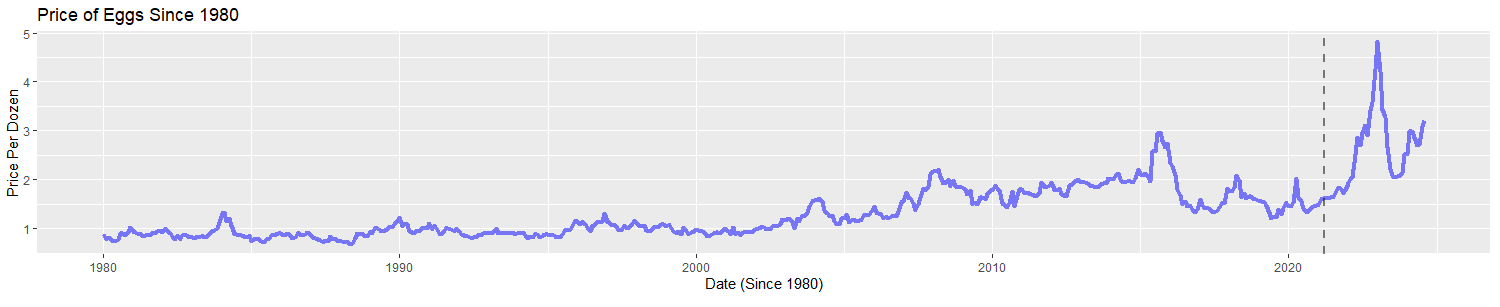
The dotted line in that graph shows the date that Biden’s American Rescue Plan was passed. You can see how shortly afterwards egg prices rocketed. In February of 2020 the average price of a dozen eggs was $1.44. Two years later, in February of 2022, it was $4.21—a 290% increase. In August 2024, the month before the debate? $3.20, a 221% increase over pre-Covid levels.
That’s just eggs, of course. But it reflects a reality that many middle-class people are experiencing now: basic things cost a lot more than they did, to the point where people feel it. And that’s before factoring in hidden costs, as well, like the fact that we now tip all of the time in situations where we wouldn’t have before.
It’s also clear that the inflation is a Biden thing. It happened after the government was handed off to him, and (mostly) after the American Rescue Plan Act was passed (the dotted line below represents the passing of ARPA on March 11, 2021).
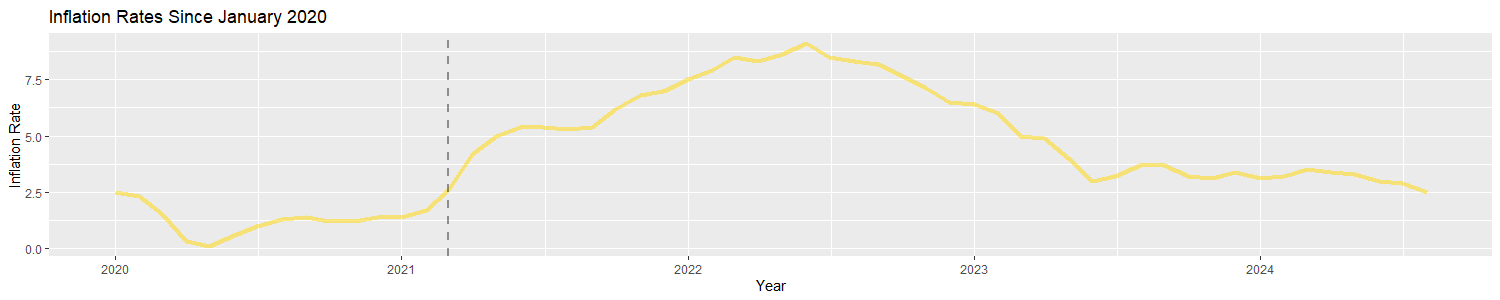
You could make an argument, I suppose, that Biden inherited an economy that was booming, post-pandemic. When Donald Trump passed the reins to him, the stock market was surging in a simple, mostly linear upward trend, and it continued accelerating for a long time after he assumed office. But if you look at the trajectory of inflation in the graph above it is pretty clear that, while the booming market may have been a pandemic thing, the inflation was a Biden thing.
But… we don’t have high levels of inflation right now. Biden’s administration got it under control. Of course, we have to also deal with the fallout of the inflation happening in the first place. Prices are still high. And we also have to deal with the fallout of him getting it under control; I’m a real-estate agent and I got to watch the effects of Biden’s heavy-handed manipulation of the housing market firsthand.
All in all, though, Trump is right—people are feeling the hurt, and the Biden administration (and by proxy Kamala Harris) has to own this one.
But I have thoughts on that too.
So what happened?
These graphs tell a familiar story. The Trump administration scrambled to get Covid under control and cocked it up. However, they benefited from an economic bounce-back that appears more like a force of nature than the result of a particular policy decision—while Congress played a part, it’s probably best thought of as a mass scrambling of the entire United States to cope with the new realities of Covid.
Trump wants to claim credit for this and in one sense, he can: he was the man in office when this all happened. But it’s likely that we would have bounced back in a similar way if it had been someone else, like Clinton, or Sanders, or Jeb Bush.
Trump’s primary concern during that time seems to have been economics. He seems to fancy himself an economic mind, so he likely focused on steadying economic indicators like inflation and unemployment, and succeeded. By the time he passed the government to Biden he had achieved a Trumpian stability: low inflation, steadily decreasing unemployment, and (through little virtue of his own) an increasingly competent Covid response.
Then Biden came in and, caring about the social realities behind the graphs, he decided to help the little guy. He poured massive amounts of money into an economy that was already bouncing back, adding his own considerable force to the bounce, sending it further into the sky than it would have gone on its own. This drove unemployment rates down rapidly but, as a predictable side effect, inflation soared.
It was the quintessential Democrat move: Biden saved the suffering little guy but the cost was passed on to the collective. Trump, meanwhile, was the classic Republican: he did a horrible job at alleviating front-line suffering, but he kept inflation down.
Beyond that, the thing that strikes me about this exercise is just how little control either administration had over events. It doesn’t appear to me that Trump can claim much credit for the resurgence of the economy under his watch, but conversely it doesn’t seem that he shoulders the blame for the spike in unemployment.
Don’t get me wrong—this is not a defense of Trump’s performance during his time in office. What I am saying is that the economics appears to be a different beast entirely from the pandemic response, following its own rules. Remember that the stock market cratered before the body count reached 500, and resurged afterward even though tens of thousand of people were dying.
The Biden-Harris administration has to own the inflation that happened after they took office, but I’m skeptical about where they could have done better. They inherited a country where millions were unemployed and addressed it (along with a raft of other social ills and Russia’s invasion of Ukraine) by pumping money into the economy. Unemployment dropped, but the magnitude of the inflation that followed seems to be disproportionately high—and even with that, they got it under control during their administration.
And, while taking all that under consideration, it’s also worth remembering: Both Trump and Biden/Harris were dealing with the fallout of an unprecedented event. We don’t have any sort of historical precedent to tell us how this could have (or should have) been handled.
There’s much more to unpack here. It’s clear to me that I lack important context that would help me understand things like the magnitude of the inflation that followed Biden’s American Rescue Plan, or what specific actions Trump took that may have helped (or hindered) the United States’ response to the pandemic.
But also, that’s the point of this article. Remember: everything I’ve covered here is the result of spending just a little bit of time investigating what went on behind the scenes of a five-minute exchange between Trump and Harris. The debate is just the sound of waves lapping against the shore—behind them there is an entire sea of roiling details that most of us know nothing about.
Worse still is the knowledge that the people in power like it this way.
Thoughts? Comments? Feel free to vent below.
This week’s song — If You Say So
Lyrics by James Horton
Audio generated via Suno.com
Verse One
He's a burned out blaze of glory
As he stands at the stand today
On his lips an old old story
About how the world got this way
He's the sad, sad little king
Of a sad once-golden tower
And his heart aches for the way-back-when,
Back when he still had power
Bridge
And thus, his empty roar:
”Those losers have to go
The world was so much better then,
Back when I had control”
Chorus
And I say
Sure, if you say so
Alright, if you say so,
That's right, if you say so,
I'm sure you had it under control.
I say
Sure, if you say so
Alright, if you say so,
That's right, I won't say no,
I'm sure you had it under control.
Verse Two
And hey, here comes the challenger,
Her shadow loomin' large
She got that power suit, those navy boots
That smile that says she's in charge
She's got the rizz, (hey) she's got promises
'bout a shinin' future glory
And maybe it's 'cuz I'm gettin old
But I swear I've heard this story
Bridge
And yet, her neon smile:
She swears it all was him
And hey, won't the world be grand—
As long as we help her win?
Chorus
So I say
Sure, if you say so
Alright, if you say so,
That's right, if you say so,
I'm sure you've got it under control.
Yeah I say
Sure, if you say so
Alright, if you say so,
That's right, if you say so,
I'm sure you've got it under control.
Interlude
Maybe the world is just crazy,
Or maybe the crazy is me,
But is it so crazy for me to believe
That there's no one steering this machine?
Chorus
So I say
Sure, if you say so
Alright, if you say so,
That's right, if you say so,
I'm sure you've got it under control.
And I sing
Sure, if you say so,
Alright, if you say so,
That's right, I won't say no,
I'm sure you've got it under control
Outro
(Sure) If you say so
(That's right) If you say so
(Alright) if you say so
(Let's ride) if you say so
(Hey hey) if you say so
(Okay) if you say so
(No way) I won't say no
(Hey hey) if you say so
Footnotes
Croatia is just a random example. Whatever the shenanigans there are, I know nothing about them. But people are people, so of course there are shenanigans. It’s what people do.
I would love to construct an action-by-action timeline of the Trump administration’s response to the pandemic prior to the handoff to Biden in 2021, as well as an action-by-action timeline of the Biden administration’s response post-handoff. Contact me if you’re up for talking about this.
I suppose that if we lived in the chimp-verse that might not be the case, as it would imply a lot of other things already going wrong with our government. Please forgive my hyperbole—but I hope you were amused by it.
The other two assertions—about the pandemic, and about the January 6th riots, are each entire posts in their own right, though they’re less amenable to the data-oriented approach I’m trying to use as the centerpiece of this article.
My understanding is that the data prior to 1948 represents a single month out of the year—December—rather than an average of the year. If I find any information that contradicts this I will report it and change my approach accordingly, though it is worth noting that even if that is the case it will not impact the conclusions reported here.
Technically you could extrapolate from this data and estimate that the unemployment rate in April 2020 was last seen in September or October of 1940, but we don’t have that data measured. The last measured data point that was greater than April 2020 came from December 1939. Really, though, that’s just semantics—”Since the Great Depression” is a broad enough statement that we can allow a year or so of give in our graphs.
Damn. This was an excellent analysis and overview. If I recall correctly, the egg situation had mostly to do with disease outbreaks (and meats as well). I don't know, I don't eat animals, so I only remember it from the periphery. I think that's right?